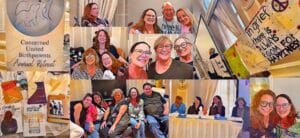
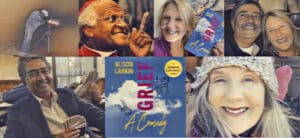
I returned to the CUB (Concerned United Birthparents) Retreat for the second time this year in Atlanta, Georgia, October 17-19, 2025. After my experience at the 2024 retreat, I knew what waited — the warmth of a community where I feel held, heard and supported. A year always feels too long to be away from those who know me in a way no one else in my world can. What I didn't anticipate was how this year's retreat would give me language for something I've carried my entire life but never quite had words for: liminal loss, and its quiet companion which I dub—liminal hope.
At the 2024 retreat, I had been estranged from my first mother for the better part of decade. It was shortly after that that she reached back out to me asking for a second try, a request I did not know and still don’t know what to do with. If you are an adoptee or first parent you know this is HUGE, and SCARY, and RISKY, and HEAVY, and I had no idea how much all of it weighed in my psyche until it kept bubbling up throughout the retreat.
In the arms of my community, I let the grief flow and found the support I needed as first mothers and adoptees held space for me to explore the tangle of emotions the idea of a reunion do-over evokes. That’s the odd thing about healing in this community, it’s often two steps forward one step back, and there really isn’t such a thing as being healed fully, at least not yet for me. Yet it is the beauty of the community in that they meet you where you are, no judgement, no shame, just loving presence and support.
Starting Us Off:
As attendees gathered with excitement and emotion at our opening ceremony, the city stirred equally charged due to the No Kings March ramping up just blocks away. This offered the opportunity to go into the street and make our voices heard as well, and some attendees did just that. However, during opening marks, our wise and wonderful CUB leader Leslie Pate Mackinnon started us off with a firm and funny reminder to check our ideologies at the hotel doors. "No Politics. No religion. Talk about sex all you want, after all that’s what got us here.”
While her firm remarks drew laughs, they were also a reminder that we were joining together to hold space for the raw vulnerability of others and the complicated truths that adoption creates. We were there to talk about: identity, loss, reunion, rejection, hope, and everything in between.
Friday Morning: Navigating Reunion's Emotional Rollercoaster
Navigating the Rollercoaster of Reunion
The retreat kicked off Friday morning with a panel that didn't sugarcoat the topsy turvy path of reunion. Leslie Pate Mackinnon (first mother & LCSW), Chris Thomason (adopted person), April Dinwoodie (adopted person/podcast host), and Amy Seek (first mother/author) explored the emotional and relational challenges of reunion, covering open adoptions, transracial and foster-care adoptions, and even GSA (Genetic Sexual Attraction).
Chris Thomason's words hit home: "Reunion is horrifyingly scary and all about rejection."
He spoke about pulling away and ghosting—behaviors that are often a form of self-protection, and which I, as explained above, am in the thick of. The panel addressed how reunion can reveal or reshape identity, and how the fear of rejection looms over every text message, every holiday invitation, and every moment of vulnerability.
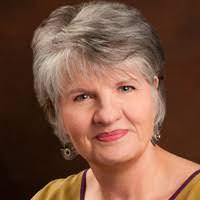
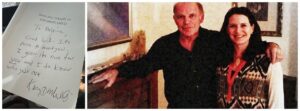
Leslie Pate Mackinnon, Photo Courtesy of Leslie.
Having been through two reunions myself with one going horribly wrong and the other swimmingly for the most part, I felt this panel offered invaluable insight for those considering or just entering this part of their journey.
Speaking on her own reunion roller coaster, Leslie's reflection offered the trademark wit we all love her for: "I've never been so high in my life, and let me tell you I've been high before."
For more reunion tips check out 11 Adoptee Tips for a Successful Reunion.
You’ve Got Siblings
Friday afternoon’s panel also touched me deeply as it tackled the complicated dynamics of sibling relationships in adoption. Having met two biological brothers, one with which I am in active reunion and one that is lost to me, this talk also deeply moved me.
First mother Linda Reboulet and her daughter Louise Okuri, reunited adoptee Danny Fulgham and his sister Adrienne Schnelle, discussed managing relationships between raised children and adoptees, and how adoptees navigate two sets of siblings—one they grew up with, and one connected by biology— a beyond complicated road to navigate as well, as I wrote about here in my post Adoptee Life & The Outside In.
Practical and honest, this session addressed jealousy, loyalty, boundaries, and the unique grief that comes when siblings don’t want what you want, or when connection doesn’t automatically flow.
Reclaiming Story with Dr. Liz DeBetta
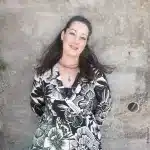
Friday afternoon, I chose the bonus session with Dr. Liz DeBetta: “Migrating Toward Wholeness.” Dr. Liz, an adoptee, author, and scholar-artist, who I had been following for several years but never met in person, led us in storytelling as a healing practice—a creative, trauma-informed framework that helps integrate identity and reclaim voice. Among several of the writing prompts she shared, her prompt “There is a room inside me where…” appealed to me, and I dove in. What emerged was this:
There is a room inside me where chairs don’t move but time rearranges everything, where faceless figures dissolve into walls, revealing time lost, tomorrows taken, memories unmade, where a draft of longing topples the hope that long sat on a mantle of possibility, and now lays shattered on the floor.
Writing in community, with Dr. Liz holding space, tapped into a deep well of emotions, and I found it interesting how the safety of the space and the community of others allowed me to drop much deeper into my pain and find more vulnerability in its expression, and it appeared to do the same for the others in our group as well. Tears and ink flowed and in the process we wrote, held and healed.
Saturday: Living in Limbo and Telling Our Stories
Living in Limbo: The Unique Grief of Liminal Loss in
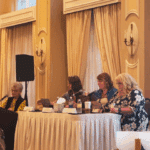
Saturday morning’s session, the most emotional by far, gave us the language many in the community have been searching for our entire lives. Amy Barker (adoptee and first mother and LMHC), Jennifer Joy Phoenix (first mother and LSWAIC), and author and first mother Candace Cahill explored how grief is experienced across cultures and dove into the unique liminal loss in adoption—loss that is vague and ambiguous and ever-present and not publicly mourned, the emotional in-betweenness that creates a sense of displacement that never quite resolves.
Amy Barker’s reflection described it best: “I’m living with the presence of absence and the absence of presence.” That’s it. That’s the adoptee / first parent experience in one sentence.
Liminal loss is vague, ambiguous, ever-present, and not publicly mourned. There are no funerals, no anniversaries, no casseroles delivered to your door. It’s a grief society doesn’t recognize, but it’s real, and it’s exhausting. This panel gave us tools to name it, sit with it, and move through it without pretending it will ever be “fully resolved.”
Telling Our Stories in Media & Print (You Know I Loved This One)
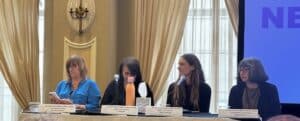
Saturday afternoon’s session, Telling Our Stories, assembled and excellently moderated by first mother Eileen Drennen, brought together four writers who shared how adoptees and birthparents get their stories out into the world. Susan Kiyo Ito (author of I Would Meet You Anywhere), T.J. Raphael (host of Liberty Lost Podcast), Jean Kelly Widner (author of The Adoption Paradox), and Abbi R. Johnson (advocate and creator of @voicelessbirthmother) each brought a different medium and perspective.
This powerful panel modeled that there’s not just one way to be heard. Whether through memoir, journalism, podcasting, or social media advocacy, each panelist showed how reclaiming our narratives is an act of healing and of advocacy. If you have not heard the Liberty Lost Podcast featuring first mother Abbi R. Johnson, go listen NOW.
Guided Journaling and Sound Sanctuary
On Saturday morning, I participated in Candace Cahill’s guided journaling sessions. Candace, author of Goodbye Again, was there to facilitate the session where we processed emotions tied to adoption and loss through writing. Although Candice lost her voice and could not fully facilitate, Beth Jaffe, first mother and author of coming memoir “Choiceless, A Silenced Birthmother Speaks,” jumped in to assist and attendees enjoyed the bonus of Beth’s beautiful talent as a writer and healer as well. One of the prompts led me to create an acrostic poem using “Black Market”:
Bought as a baby,
Loved by my saviors despite the
Addictions driving them,
Compromised by their
Kept secrets,
Mad mother raging,
Always sorry after, as she
Regarded herself unworthy of the child whose
Kinship she could never share,
Eagerly searching for the mother who was
Taken away.
The retreat also offered a Sound Sanctuary with Hope Sacher, RN, NC-BC—a restorative, gentle space using sound healing to help participants rest, release, and reconnect. It was a beautiful reminder that healing isn’t just intellectual or verbal—it’s also somatic, vibrational, and body based.
Evening Programming: Story Hour and Documentary Screening
CUB Story Hour: Finding My Voice
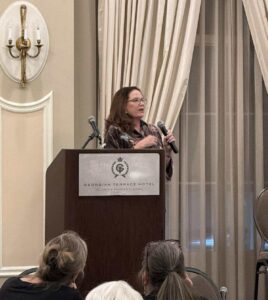
Friday night brought the now-beloved CUB Story Hour. When I arrived at the retreat, I came prepared with an excerpt from my upcoming book, WONDERLAND: A Black-Market Baby’s Rise from the Rabbit Hole, thinking I could simply read from it as I did during the storytelling session the prior year. But Amy Seek, who organized the Moth-style format, had other plans.
She gently encouraged me—along with the supportive audience—to put down the pages and tell a story instead. No reading. Just me, my voice, and my truth. I won’t lie: it was terrifying. There’s safety in the written word, in the carefully crafted sentences you can hide inside. But standing there without my manuscript, sharing a 5-minute story from the heart, was one of the most vulnerable and liberating experiences I’ve had.
The room held me. Adoptees and first mothers listened and applauded—not for polished prose, but for the vulnerability. A wonderful reminder that our stories don’t have to be perfect to be powerful. Sometimes the most healing thing we can do is simply show up, speak our truth, and trust that we’ll be heard.
Listening to the other narratives throughout the evening—each one deeply personal and courageously told, reinforced the power of storytelling to create connection and collective healing. The Moth format strips away pretense and invites authenticity, and that’s exactly what everyone needed that night.
All You Have is Love Documentary Update
Saturday evening, director Lisa Elaine Scott gave an update on her documentary All You Have is Love, which features many people in our community and explores the complexities of adoption through intimate, personal stories. It was inspiring to see how documentary filmmaking is capturing the nuances of adoption that mainstream media so often flattens, sugar coats or ignores. And we are all so excited to support Lisa as she works to bring the reality of adoption to mainstream audiences.
Liminal Loss—and the Liminal Hope We Don’t Always Name
Throughout the weekend, I kept returning to this idea: adoption trauma is about liminal loss—loss that is vague and ambiguous and ever-present and not publicly mourned. But in our community, it feels to me it is also connected to hope.
I think there is something called liminal hope—an unspoken, against-all-odds hope that you will find your missing other, that estrangement will heal, that closed or hurt hearts will heal. It’s hope without guarantees, but not without precedent. I heard it everywhere this weekend—in panels, in hallways, in the way people stayed to listen when the stories got hard.
Liminal hope doesn’t erase liminal loss. But it sits beside it, refusing to let go.
Final Thoughts
The CUB Retreat 2025 was a powerful reminder that we are not alone in this constellation of loss, longing, and resilience. From the opening to the closing brunch, every session, every conversation, every moment of shared silence reinforced that our stories matter, our grief is real, and our hope is valid.
Whether you’re a first parent, an adoptee, or someone who supports us, please consider attending next year’s retreat. The connections made, the language gained, and the healing experienced are truly invaluable.
To learn more or to register for future events, visit the CUB website. Let’s continue to support one another, spread awareness, and work toward adoption reform. Because somewhere out there, someone is waiting to hear that they’re not alone.
Scholarship Fund
Before I close, I want to highlight the CUB Scholarship Fund. Your donation helps cover registration costs for individuals who might not otherwise be able to attend. These scholarships offer more than financial support—they provide the gift of community, connection, and healing. If you’re able, please consider making a donation. Every contribution helps bring someone to this meaningful experience and makes the CUB Retreat accessible to all.
For more information about adoption reform, support resources, and upcoming events, follow my blog and visit www.concernedunitedbirthparents.org.
Lastly Please Subscribe to My Quarterly Newsletter
Subscribers get my 47-page guide to healing (free).